
Faith

Peace

I wasn’t able to be with my kids to celebrate Advent tonight because…sometimes life isn’t peaceful. Peace is one of the things that fits under the umbrella of “already, but not yet.”

We read in Isaiah 9:6 and 7 that Jesus would be called the Prince of Peace and that there would be no end of peace. And in Luke 2:14, as the heavenly host proclaimed the birth of Jesus to the shepherds, they said, “Glory to God in the highest, And on earth peace among men with whom He is pleased.”

Jesus clearly came to bring peace—not just in a quiet and calm sort of way. The peace Jesus came to bring, the peace Jesus is the “Prince of” is the Hebrew word “shalom”. Shalom encompasses so much more than quiet and calm. It involves more than just the absence of fighting and wars. Shalom is completion, health, prosperity, wholeness in relationships (both with God and man) and safety.

As Prince of Peace, Jesus has reconciled us to God, He teaches us to love and to make peace with our fellow human beings, He delivered us from the bondage of the sin that warred within us, He provides for our physical needs and heals our bodies.

And yet, our world is still broken. Wars are still fought. Relationships still break down. Our bodies still become sick. We still experience trouble and sufferings.

Let me be clear, the seeming absence of peace or shalom by no means we are out of favor with God, that we lack faith, or that He has abandoned us. No! Jesus told us that we would experience tribulation or trouble (John 16:33), and in Romans 8, Paul writes that creation, and we ourselves, are groaning and longing for freedom and the realization of our hope in Christ.

We live in the day of “already, but not yet”. We experience some shalom, but not its entirety, not all the time. We have a taste or a glimpse of what is to come, but we live in the hope of the its complete fulfillment.

It is this hope that gives us strength in the times that are not peaceful. In Romans 8:18, Paul writes, “For I consider that the sufferings of this present time are not worthy to be compared with the glory that is to be revealed to us.” Sometimes we do experience suffering, hardship, troubles, and tribulation. And yet, glory is waiting up ahead.

When I read Romans 8:18, I think of a hike up a steep mountain. It is difficult. Your legs and lungs burn. But finally, you reach the top, and the view is breathtakingly glorious.

Later in Romans 8, Paul uses the analogy of the pains of childbirth—and I’ve experienced that a few times. Yet, as my youngest daughter was placed on my chest, I experienced an overwhelming sense of joy. The pain of childbirth (unmedicated that one time 💪🏻), was worth the joy of my new baby’s presence.

Whatever we face today, whatever ways we and our world lack shalom in this life, we can walk in the confident expectation of the glorious fulfillment when our Prince of Peace returns and all is made right.
Faith

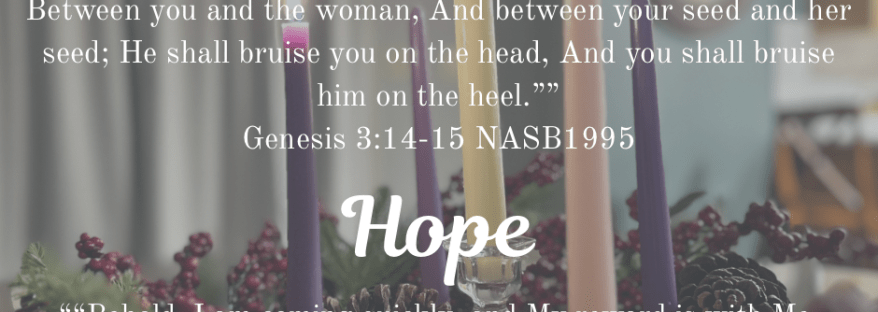
Hope

As we observed Advent this evening, I was led to Genesis 3:15: the protoevangelium. This is the first Scriptural reference to the promise of the Messiah. From the Fall, God had planned to send Jesus to be our Savior. The protoevangelium is the first of mannnnnny prophecies pointing to Jesus, and these prophecies gave people hope for the day the Messiah would come.

As I told my children about these promises and the hope they gave, I was reminded that this hope is not merely wishful thinking or a lovely dream. The hope that God gave people for the Messiah’s coming could more fully be expressed as expectancy or anticipation. God’s Word is true. His promises are sure.

While Jesus walked the earth, He promised to return, and in the final chapter of Revelation, the last of the words in red say, “Yes, I am coming quickly.” (Revelation 22:20)

In the same way men and women waited hopefully for His coming, we now watch and wait and hope for His return. Though our perception of the word “quickly” may differ from Jesus’, we can be sure, we can trust that as He fulfilled promises and came 2,000 years ago, He is indeed coming again.

Faith

Here I Go Again

Last week I found myself in a regrettably familiar place, in a struggle between hope and a self-protecting negativity. We listed our house for sale three weeks ago. If you’ve ever sold a house, you know it’s not the most fun process. Between having to keep the house in showing-ready condition with four young kids, having to leave the house without a plan of where to go, and the uncertainty of how long it will take to sell, I’ve definitely experienced moments of exhaustion and frustration.

We had been told there was a lady who loved our house and was going to bring her husband back through the next weekend when he was back in town. Monday came, and they had not returned. I told my husband I didn’t think they were coming, and he accused me of being uncharacteristically negative. I explained that I didn’t want to hope for something I didn’t think would happen because I didn’t want to get disappointed. And…then I realized, I was back to using negativity to protect myself from being disappointed, which only served to make me disappointed in myself for reverting back to something I thought I had outgrown.

Before meeting my husband (9 years ago yesterday!), I had multiple people attempt to set me up with eligible young men. Each time, I ended up disappointed. I decided it would be easier, safer to assume I would end up single because hoping I would get married and hoping relationships or potential relationships would result in marriage left me disappointed.

After getting married, my husband and I had months of praying and waiting for our first child and over a year of waiting and praying for our third. I found myself worn out by the cycle of hope and disappointment each month. I stopped wanting to hope. I started assuming I would only see one line on the tests.

I wrestled with my lack of hope because I knew hope was important. Faith, hope, and love are three things that remain (1 Cor 13:13). Faith is the substance of things hoped for (Hebrews 11:1). Clearly hope isn’t something I can just wall my heart off from.

And yet, when faced with uncertainty in our house sale, I found myself choosing not to hope that the expected couple would be back through or buy our house. I believed doing so would save future me from being disappointed. I felt like a failure. How had I gotten through extended singleness and a total of over a year and a half of infertility without learning not to fight hope?

Finally I remembered the lesson I had learned: where I put my hope matters.

Putting my hope in a potential relationship resulted in disappointment. Putting my hope in positive pregnancy tests resulted in disappointment. Putting my hope in someone coming to buy my house would result in disappointment.

Instead of putting my hope in people, solutions, or outcomes, my hope must be placed in the One who never fails, is never late, is always faithful, and knows everything.

Putting my hope in God turns my eyes away from things and away from what and when I think would be best. In placing my hope in God, I wait expectantly for what God will accomplish and when He will accomplish it. While people and situations can let me down, I trust God’s heart. I know He has the best plans and that He is growing through the wait. I know His timing is perfect, even if it doesn’t often line up with my ideal timing. I know He sees the big picture.

What are you hoping for? What have you placed your hope in? How would things change in your heart and mind if you put your hope in God and expectantly waited for Him to do what only He can do?